


Advertising Case Study
Transforming Direct Mail: A Strategic Overhaul for University Recruitment
Background
In a world dominated by social media and digital advertising, direct mail advertising has taken a back seat. That was certainly the case with one of FabCom’s long-term clients, prompting the Phoenix-based strategic marketing and advertising agency to take action. FabCom’s client, a university offering both undergraduate and graduate degrees, was seeking a new partner for not only the printing and distribution of a series of direct mail touchpoints to its leads… but for the strategic thinking for a complete rebuild of the architecture and algorithms for an automated nurture funnel system.
What is a Direct Mail Funnel?

You might be wondering… what is a direct mail funnel, and how does it work? While each funnel is customized and tailored to a client’s specific needs, a typical direct mail funnel consists of a series of physical marketing pieces that are sent out by mail, designed to communicate with leads on an ongoing basis to keep them engaged throughout the various stages of the customer lifecycle journey. These direct mail touches are either time-triggered and/or deployed based on pre-defined actions that signal qualification for certain pieces or sequences. These print touchpoints are often supplemented with digital communications, such as emails and text messages, which are part of a separate, but connected, digital lead nurture funnel.
As leads are generated via inquiry forms, phone calls, events, conferences, and other sources, those who qualify to be enrolled in the direct mail funnel are batched and sent to the mail house to receive the first piece in the funnel. From there, the funnel has scheduled windows for when the next piece will drop. A lead will continue to receive various physical touch points until they take certain pre-defined actions that qualify them to be unenrolled from the funnel.
The Challenge
When FabCom inherited the university’s direct mail funnel from a third-party vendor, it didn’t take long to uncover why the system was underperforming. Missed drop dates had become routine, with slow production turnaround times pushing mailings out so late that leads often received them well past the intended window of influence. The materials themselves raised additional concerns—outdated materials were being mailed and reported inventory counts didn’t reflect reported usage.
Moreover, the funnel’s cadence and content had fallen out of sync with the university’s evolving goals, resulting in mixed or even conflicting messages to prospective students. Behind the scenes, printing and postage processes lacked transparency, leaving the client in the dark and often questioning invoices. The result was a funnel that wasn’t just inefficient—it was misaligned, opaque, and losing valuable opportunities at every step.
Objectives
FabCom wasted no time overhauling the university’s direct mail funnel from the ground up. The primary objective of the initiative was to replace the outdated, inefficient system with a new intricate direct mail funnel designed for precision, transparency, and alignment with the university’s recruitment goals.
To overcome the issues of the prior system, a technical migration was required, as well as a strategic redesign of the funnel’s infrastructure, cadence, algorithms, reporting dashboards, and content to better meet the needs of the university’s target audiences.

- Improve funnel infrastructure.
- Align creative/content with the university’s evolving direction.
- Ensure timely and consistent mail drops.
- Reduce waste and eliminate outdated materials.
- Increase transparency in reporting and inventory.
The Solution
Known not only for its creative innovation, but also for forward-thinking strategic vision, FabCom set out to strategically design, outline, and develop a real-time automated direct mail funnel system. This system would deploy time-triggered and action-based physical mail touches tailored to three key audience segments: traditional students, non-traditional students, and graduate students.
By leveraging the university’s existing CRM, the funnel will utilize real-time database pulls, automated workflows, dynamic inventory reporting, and activity/fulfillment reporting dashboards. This ensures database accuracy, enhances fulfillment transparency, streamlines operations through automation, and equips the marketing teams with the tools necessary to optimize student recruitment and engagement strategies.
Infrastructure Revamp
FabCom began by thoroughly auditing the university’s existing direct mail sequences, mapping every touchpoint to identify where timing and messaging were misaligned. Originally structured as a single funnel, the team broke it out into three distinct workflows—one for each target audience: traditional, non-traditional, and graduate students. This segmentation was essential, as each group has vastly different demographics, psychographics, interests, motivations, and decision-making behaviors.
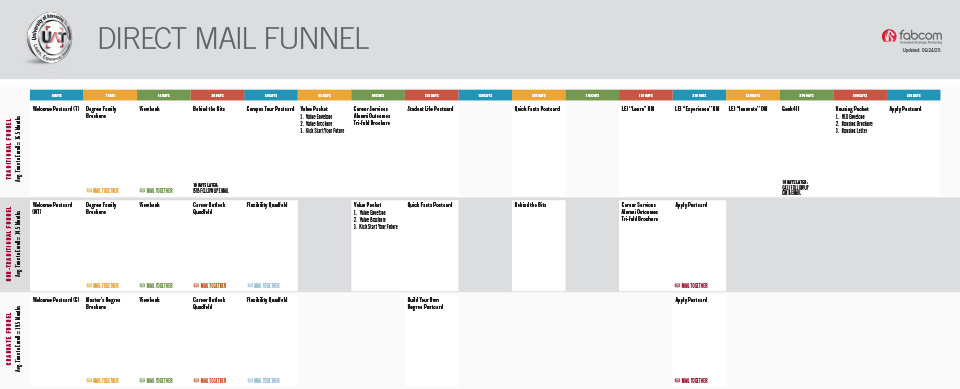
From there, FabCom redesigned the cadence of each workflow to ensure every piece spoke directly to its specific audience and reached prospects at the moment they were most receptive. This approach accelerated “speed to lead” and guaranteed that each mailing delivered the right information at the right time in their respective recruitment journeys.
To eliminate manual delays and errors, the agency engineered a custom program that automatically pulls new lead lists each week based on predefined parameters and qualifications. On the production side, FabCom configured an automated process that instructs the mail house’s print press to select and prepare the correct direct mail piece for each associated list, creating a seamless handoff from data to print.
Next, FabCom created a custom back-end dashboard for the mail house to continually update with the status of each batch. This dashboard integrates with the university’s CRM to automatically track leads with mailing drop dates, enabling the client to view live reporting on direct mail statuses inside their native CRM. Real-time reporting dashboards were also developed to provide the client with instant visibility into every stage of fulfillment, from weekly list pulls to print queues, total quantities batched versus dropped, and the precise drop dates for each piece.
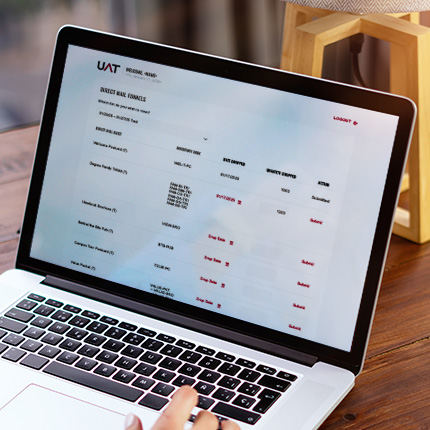
Additional reporting dashboards were created to showcase website activity and engagement metrics tied to each direct mail drop, including QR code scans, unique URL visits, and downstream website activity such as subsequent page views, session durations, conversions, and applications started or submitted—allowing all digital engagement to be directly attributed back to the physical mail piece.
Lastly, FabCom implemented an automated return-to-sender monitoring system that feeds updated “bad address” notifications directly back into the CRM. This tightened quality control and improved reporting accuracy, ensuring data remained current. Together, these innovations transformed the direct mail funnel into a streamlined, transparent engine that supports rapid, data-driven student recruitment.
Content Refresh
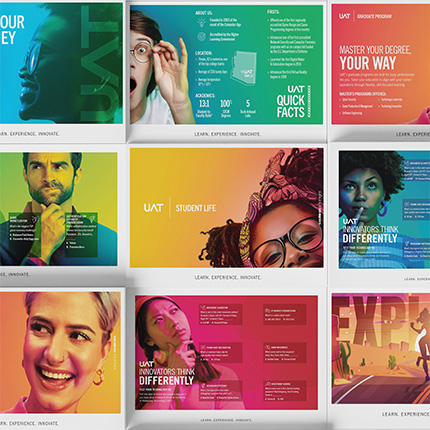
The Scottsdale marketing agency, FabCom, began by evaluating all existing collateral to update and refresh materials, remove outdated pieces, and add new touchpoints to highlight the university’s latest benefits, degree offerings, and campus amenities. Collaborating closely with the client, FabCom ensured that every touchpoint—from postcards to brochures—reflected the updated creative vision, presenting a consistent look, feel, and voice. By blending refreshed visuals with the university’s long-standing brand identity, the team reinforced a seamless experience for prospective students.
Next, to balance cost efficiency with personalization, FabCom designed a mix of universal and audience-specific pieces. Certain institutional materials were crafted for use across all three funnels, ensuring consistent brand messaging and visual identity. Other pieces were developed in multiple variations, each featuring tailored imagery and copy to speak directly to the unique motivations of traditional students, non-traditional students, and master’s candidates. This approach allowed the university to maintain a cohesive brand presence while delivering content that resonated with the distinct interests and decision-making factors of each audience segment.
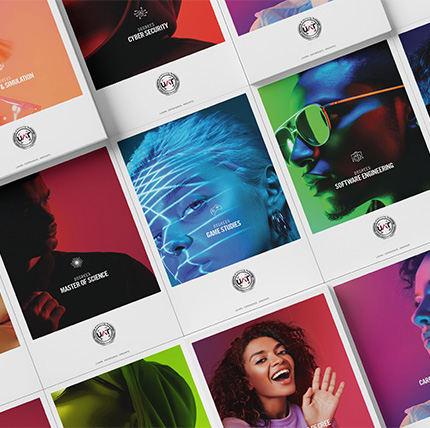
You might be thinking: “What makes their postcards or brochures any different than what I currently get in the mail that ends up in the trash?” We’re glad you asked. To overcome this, our team of strategists and creative designers collaborated to create the most intriguing, interactive physical pieces—ones prospective students wouldn’t want to toss.
To achieve this in a cost-effective manner, the funnel centered on three flagship formats: a standard half-sheet postcard (front-and-back), a trifold, and a quadfold. By standardizing specifications across these pieces, the production team was able to gang run them together, securing more favorable printing rates while still keeping each piece creatively unique.
Specialty finishes and printing embellishments were intentionally avoided, allowing clean, confident design to communicate the message. This strategic budget decision also made it possible to develop a few additional high-impact executions: an eye-catching 3D pop-up mailer, an interactive mailer featuring a degree-centric quiz with perforated pull tabs that revealed the answers, etc.

Ready, Test, Go Live
Leading up to the launch, FabCom’s skilled team of programmers meticulously tested the automated processes for batching lead lists in each audience-specific funnel, using data pulled directly from the CRM. To ensure accuracy, these automated lists were compared with those manually pulled by the client, verifying that all expected leads were correctly included for each funnel type. Once finalized, the lead lists were shared with the mail house to confirm they had all necessary data fields.
Additionally, the team updated the status of each batch list in a custom dashboard that automatically synced with the CRM to track which leads had been included and to confirm drop dates. All updates and status checks were developed using a combination of CRM workflows and APIs to create funnel delays and collect leads into different batch lists. The dashboard also included a file upload feature, enabling the mail house to report invalid or undeliverable addresses so the client could update their CRM accordingly.
The process followed a clear, repeatable sequence:
- Step 1: University provides access to a live database of new leads as they are generated throughout the week.
- Step 2: FabCom automatically pulls the database on the pre-determined day/time and transfers into the funnel for the first touch fulfillment.
- Step 3: Automated workflows scan the lead lists every morning to determine which leads are due for the next direct mail touch as it moves through the funnel. The lead lists for each direct mail touch are re-pulled prior to each fulfillment to ensure all lead information (i.e., mailing address) is up to date.
- Step 4: As leads qualify to be unenrolled from the funnel (e.g., bad address, started an application, opted out, etc.), the university actively updates record statuses to ensure those leads are not included in the real-time lead list pulls.
- Step 5: Each direct mail piece is automatically imprinted and sent to the postal office. Once the final quantity and drop date is confirmed, the mail house updates the reporting dashboard accordingly.
FabCom also implemented a custom list-naming convention with the mail house, allowing them to automatically determine which mailer is associated with each automated list as they receive them. This led to shorter delays between leads being ready and mailers being dropped.
By combining this approach with housing print materials at the mail house, FabCom reduced turnaround times while enabling more consistent inventory tracking—ultimately adding an additional layer of cost savings.
Results & Impact
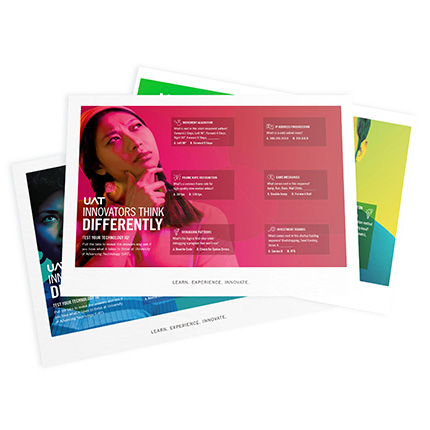
Before, the client had little to no visibility into how their direct mail funnel was performing—relying mainly on manually compiled Word document reports that were produced upon request. Post-implementation, the university gained transparent, real-time reporting dashboards with 24/7 visibility into funnel performance. Automated processes reduced errors, improved “speed to lead” turnaround times, and ensured creative and messaging stayed aligned with recruitment goals. Updated content boosted engagement, and audience-specific targeting strengthened both lead quality and the overall progression from inquiry to enrollment.
To report on activity and engagement, all direct mail pieces included unique call to actions (CTAs), tracking links, and QR codes. With that, the agency is able to report on the downline activity on the university’s website in real time including, but not limited to, page views, engaged sessions, average session durations, event conversions, applications started/submitted, enrollments, and more. Further, all analytics can be tied back to the direct mail piece.
Conclusion
FabCom’s strategic overhaul transformed the university’s direct mail funnel into a streamlined, transparent, and high-performing recruitment tool. The client now benefits from greater efficiency, reduced waste, reporting accuracy, and stronger alignment with their marketing and recruitment objectives.
Looking to optimize your marketing direct mail or digital lead nurturing strategy? FabCom, one of the longest-standing marketing and advertising agencies in the Phoenix-Metro area with 35+ years of experience, can help you transform outdated processes into data-driven, automated solutions that are not only engaging, but deliver measurable results.