

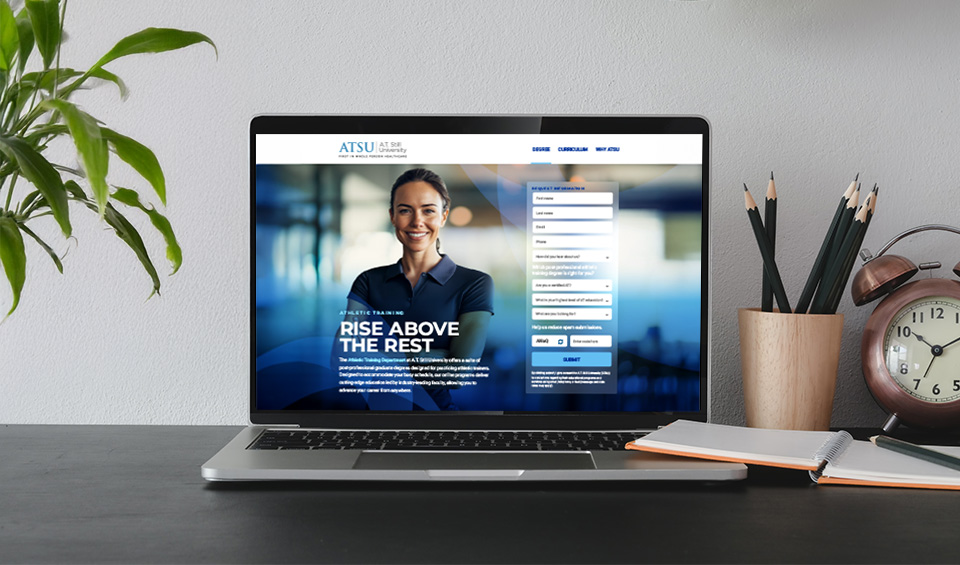
Advertising Case Study
Solving PPC Attribution and UX with Dynamic Landing Pages
Background

We’ve all experienced the frustration of clicking on an ad for a specific product or service—say, an ad promoting bold red shoes—only to land on a webpage showcasing something entirely different, like blue coats, or on a generic homepage with no trace of what initially caught our attention. This disconnect creates a jarring, inconsistent experience, leaving visitors feeling misled and causing them to lose interest in just seconds. In today’s fast-paced digital world, brand consistency and delivering a unified message across touchpoints are essential—but just as important is the ability to accurately measure what’s working and why.
One of FabCom’s long-standing clients, a health sciences university with an international footprint, faced this exact challenge. Each PPC ad campaign directed users to a specific degree page—which was an improvement over sending traffic to the university’s homepage—but still posed limitations from a performance measurement standpoint. Each degree page housed all information about the program, which could be overwhelming for users who clicked an ad seeking only specific details.
More critically, this structure created a significant ad attribution challenge. Conversions could only be reliably tied back to paid media when a prospect submitted an inquiry form directly on the university’s degree page before navigating to other pages. In reality, most users followed common and expected research paths—clicking to other pages like tuition, the academic calendar, or financial aid—before ultimately submitting an inquiry form. Once a user navigated away from the original degree page, the ability to clearly attribute that conversion back to the original PPC ad was often lost, making it difficult to accurately attribute the influence of paid media.
Recognizing that accurate attribution is foundational to optimizing media spend, creative performance, and long-term strategy, FabCom set out to implement a solution that would preserve attribution throughout the user journey while also ensuring that prospects landed exactly where they expected to go and saw exactly what they expected to see.

The Challenge
The client faced several challenges with their existing PPC campaigns. While the ads were successfully driving traffic and conversions were being logged, it was difficult to confidently measure performance beyond surface-level metrics and understand which ads were truly influencing conversions.
Because users frequently navigated away from the degree page before submitting an inquiry, attribution was fragmented—limiting insight into campaign effectiveness and making optimization decisions more difficult.
Additionally, there was a user experience consideration. While the degree pages were well-designed and information-rich, they were not structured to mirror the specific intent or promise of each individual digital ad. Images and copy were similar, but not exact matches to the ads that drove the click. Moreover, presenting all degree program details at once could overwhelm users seeking only a specific answer.
Together, these challenges resulted in:
- Incomplete attribution and limited performance visibility
- Missed opportunities to optimize ad creative and media spend
- A user experience that, while strong, was not fully aligned with ad-level intent
FabCom needed a solution for the client that prioritized accurate, end-to-end attribution while also delivering highly relevant, ad-specific landing pages that guided visitors toward taking action.
Objectives
Together, the agency and client established clear goals for the initiative, led by one primary objective: improving ad attribution and performance measurement across all PPC advertising campaigns.
Secondary to that goal—but closely connected—was the importance of delivering a seamless and intuitive user experience. When users see consistent imagery and messaging from a digital ad to the landing page, they are more likely to engage, trust the experience, and take action.
Key objectives included:
- Attribution reporting: Implementing precise tracking to understand which ads, images, headlines, and messages were driving engagement and conversions.
- User experience: Presenting information clearly and in focused, manageable sections aligned with ad intent.
- Lead generation: Increasing both lead volume and lead quality by guiding prospects to relevant calls-to-action.
- Brand consistency: Ensuring every landing page reflected the university’s brand voice and visual identity.
By aligning attribution strategy, creative execution, and user experience, FabCom aimed to create a system that supported both smarter optimization and stronger engagement.
The Solution
To address these challenges, FabCom developed a strategic digital advertising framework built around dynamic, campaign-specific PPC landing pages. Unlike traditional PPC traffic paths that send users to a main homepage or broad product/service page, campaign landing pages are standalone webpages created specifically for a digital PPC campaign (and sometimes down to the ad level)—allowing for cleaner attribution and clearer performance insights.
FabCom took this a step further by making these landing pages dynamic. Imagery, headlines, and calls-to-action dynamically swapped out on the webpage to match the exact PPC ad a user clicked on, triggered by the UTM parameters assigned to each individual ad. UTM parameters are small pieces of tracking code appended to the end of a URL that pass specific information from an ad into analytics platforms. These parameters identify where traffic originated (such as the platform, campaign, ad group, and individual ad/creative variation) and travel with the user when they click through to the website.
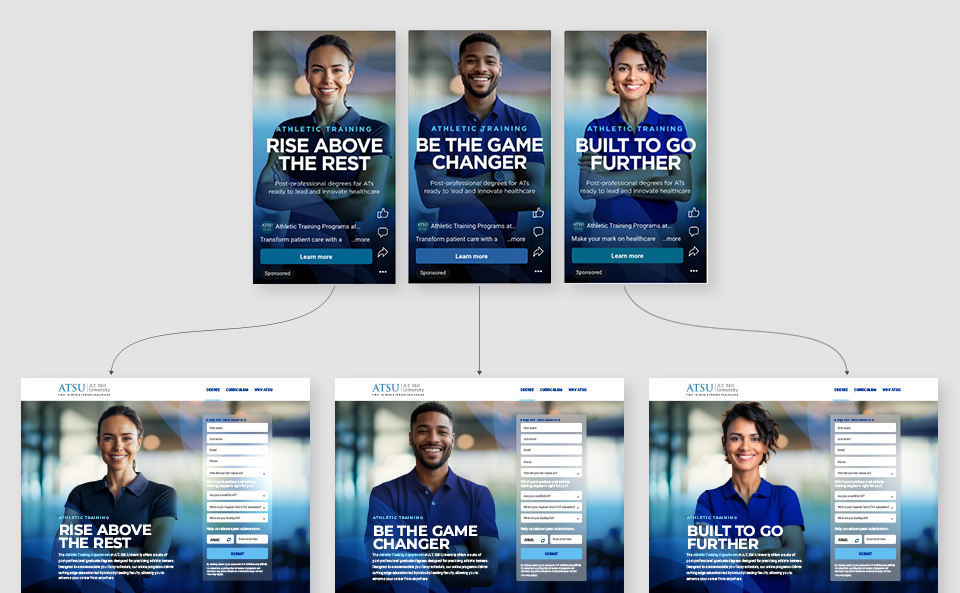
This strategic approach was designed to ensure:
- Clear, uninterrupted attribution from ad click to conversion
- Immediate imagery/messaging match between ad and landing page
- A more focused and intuitive user experience
This approach allows users to click on a digital ad and immediately find the exact information that initially caught their attention. To drive higher conversion rates, the landing pages featured a streamlined request info form and concise, focused content. By presenting relevant information in digestible portions rather than overwhelming visitors with the full degree page, the campaign landing pages guided users toward taking the next step. At the same time, strategic cross-links to full degree pages remained available—allowing users to explore further, if needed.
The visual consistency from the digital ad to the landing page created a seamless experience for users, minimizing distractions and making it easy for them to take the next step and submit an inquiry form.
The Results

The implementation of dynamic, degree-specific PPC landing pages delivered measurable improvements in attribution and performance. By leveraging UTM parameters at a granular level, FabCom was able to capture and interpret user data in real time—allowing the landing page to dynamically display select imagery and messaging, while simultaneously tracking which specific ad, headline, and creative element drove the visit and eventual conversion. This approach preserved attribution throughout the user journey and enabled precise performance analysis at the individual ad level, rather than relying on aggregated campaign data. With this strategy, FabCom gained clear visibility into which ads, messages, and creative elements were driving conversions—enabling more precise optimization and data-driven media decisions.
From a user experience perspective, prospects benefited from a more intuitive and relevant journey. Prospects were directed to focused landing pages that aligned directly with the ad they clicked, rather than a full degree page with extensive content and multiple opportunities to navigate away. This reduced distractions, minimized cognitive overload, and preserved the connection between ad click and conversion.
As a result, bounce rates decreased, conversion rates increased, and prospects moved forward with greater confidence. By creating a direct, consistent path from ad to action, FabCom improved both campaign effectiveness and the overall brand experience—ensuring each interaction was efficient, relevant, and measurable.
Campaign performance highlights for one of the university’s doctoral degrees:
- Conversion rate increase: 44.6%
- Cost per lead decrease: 79.5%
- Increase in attributable conversions: 19%
- Optimization opportunities became clearer
- Overall experience was more seamless and intentional
By creating a direct, controlled path from ad click to conversion, FabCom not only improved campaign performance but also unlocked deeper insights into what truly resonated with prospective students—fueling smarter optimization and stronger long-term results.
Conclusion
By prioritizing accurate ad attribution through dynamic, campaign-specific landing pages, FabCom successfully transformed the university’s PPC strategy into a more measurable, optimizable, and effective system.
At the same time, this approach enhanced the user experience—ensuring every ad click delivered on its promise with clarity, relevance, and consistency.
The success of this initiative demonstrates how thoughtful landing page strategy can simultaneously solve performance measurement challenges and elevate user experience—proving that when attribution and UX work together, results follow.